










R&D and Innovation
Electricity Price Forecasting
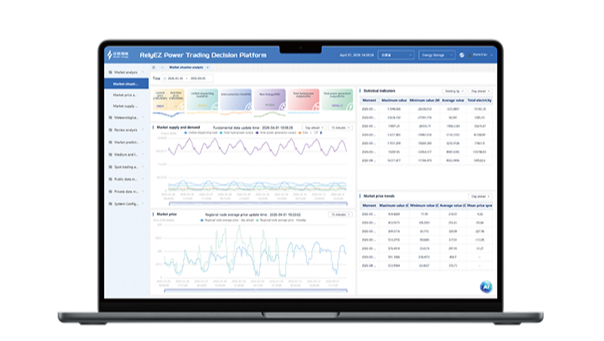
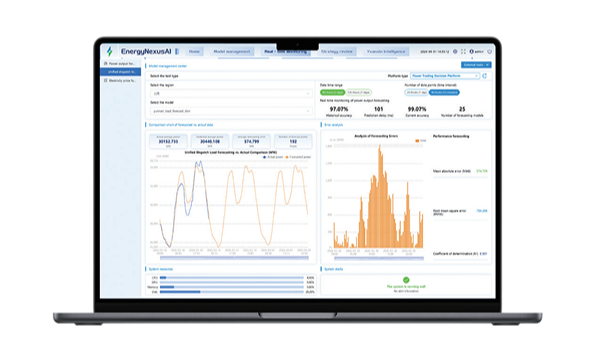
Multi-model fusion-based forecasting of electricity prices and renewable energy output provides data-driven price insights for trading decisions.
-
Multi-Model Parallel Forecasting
DNN / LightGBM / Transformer

-
Multi-Type Forecasting
Covering Day-Ahead and Intraday Electricity Prices and Market Load Forecasts

-
Renewable Energy Output Forecasting
PV & Wind Power Output Analysis

-
Model Management Center
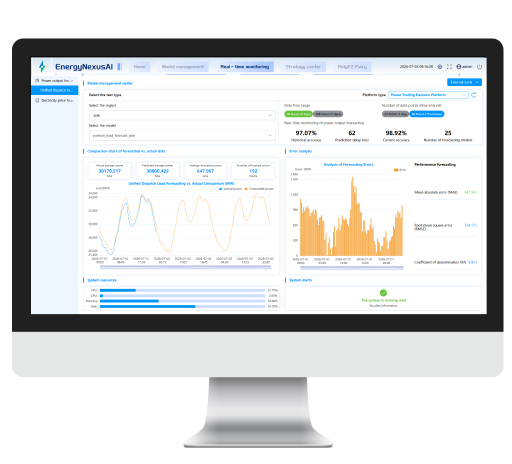
Monitoring · Comparison · Switching

Forecasting Models &
Model Management Capabilities
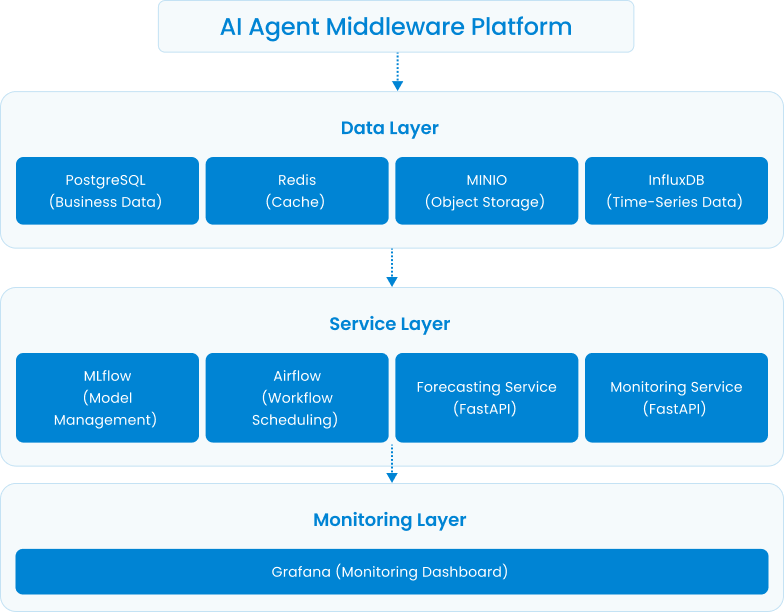
Core algorithms address diverse scenario requirements, with unified scheduling and monitoring through the Model Management Center



-
Applicable Scenario: Day-Ahead Electricity Price Forecasting
DNN (Deep Neural Network Algorithm Model)
Suitable for high-dimensional feature learning, capable of capturing nonlinear patterns in electricity price time series, and serving as the core foundational model for electricity price forecasting. Supports joint modeling of multi-dimensional features such as historical prices, load, and weather.
-
Applicable Scenario: Short-Term Power Forecasting
LightGBM (Gradient Boosting Tree Model)
Fast training and highly interpretable, ideal for short-term renewable energy output forecasting, widely used in multi-site comparisons and rapid iteration scenarios.
-
Applicable Scenario: Long-Horizon Output Forecasting
Transformer (Attention Mechanism Model)
Models long-term temporal dependencies via the attention mechanism, excels at capturing weather-driven output trends, suitable for intraday rolling forecasts and multi-step ahead predictions.
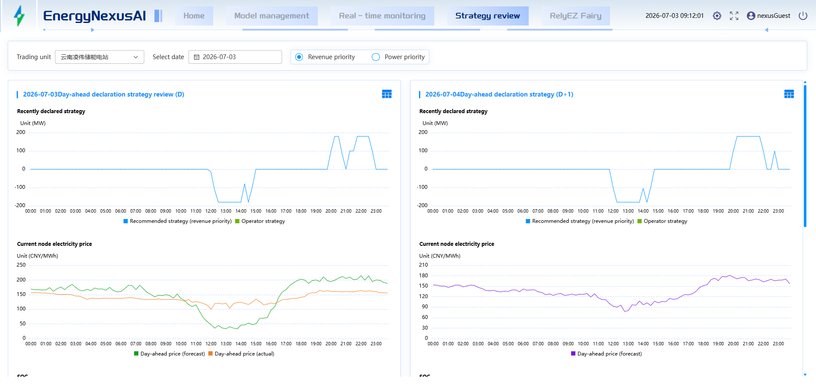
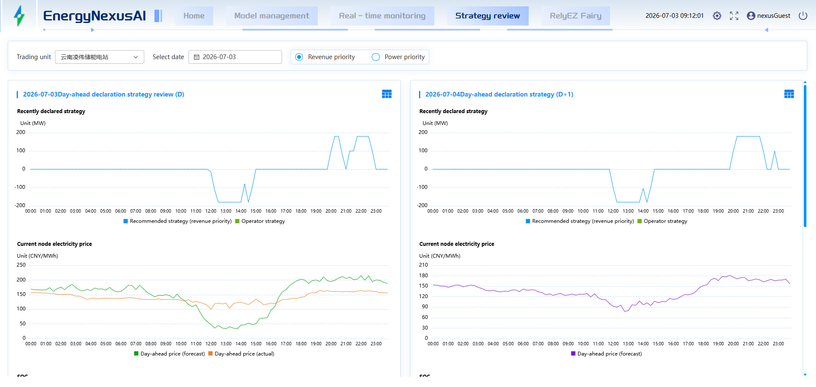
AI Intelligent Strategy
Based on electricity price and renewable energy output forecasts Generates interpretable charging, discharging, and bidding strategies through a trading agent

-

MILP Strategy Optimization
Charge/Discharge Time Windows & Power Allocation
-

Bidding Strategy Support
Price Boundaries & Bidding Volume Recommendations
-

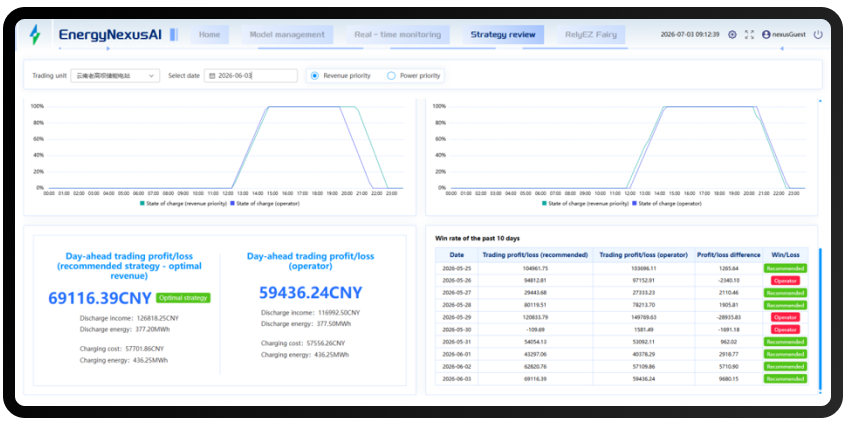
Strategy Review & Analysis
Execution Comparison & Experience Accumulation
-

Risk Constraint Management
Boundary Validation & Compliance Alerts
From Strategy Generation to Execution:
End-to-End Workflow Overview
A complete workflow from forecast data input to manual confirmation and execution, with explainable outputs and review checkpoints at every stage
-
 1
Forecast Data Input
Receives electricity price forecast curves, renewable energy output forecasts, and weather data as inputs for strategy optimization.
-
 2
Constraint Configuration
Loads market bidding rules, equipment capacity limits, SOC constraints, and compliance parameters.
-
 3
MILP Strategy Optimization
The Trading Agent uses Mixed-Integer Linear Programming (MILP) to optimize charging / discharging strategies and bidding plans within defined constraints.
-
 4
Strategy Explanation Output
Outputs charging/discharging plans and bidding recommendations, highlighting key assumptions, risk factors, and manual review priorities.
-
 5
Manual Review & Confirmation
Traders review strategy recommendations and risk alerts before confirming execution; the system does not make decisions autonomously.
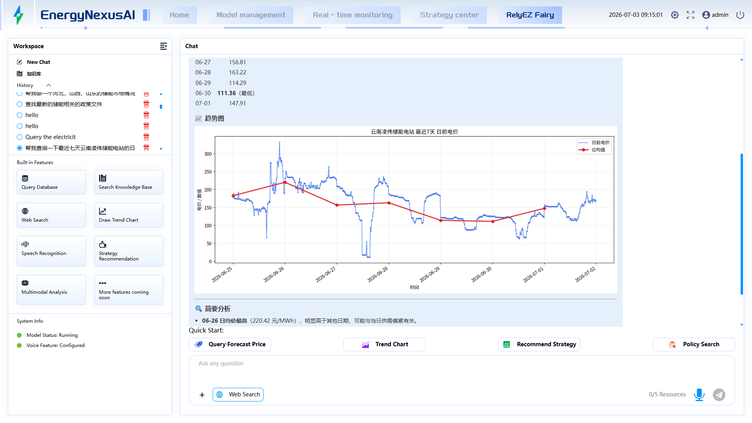
RelyEZ Fairy
AI Dialogue | Ask Questions in Natural Language and Instantly Receive Professional Insights Connects knowledge bases with analytical results to help traders review strategies and identify risks
-

Knowledge Base
Energy storage regulations and historical operational data with precise, one-click retrieval
-

AI-Powered Dialogue
Ask questions in natural language and instantly receive professional analysis and recommendations
-

Task Structuring
Automatically decomposes complex tasks into actionable, structured task lists
Three Core Scenarios Covering Key
Energy Storage Operational Needs
Capability Overview: Transforms natural language queries into multi-step tasks and automatically selects the appropriate tools for execution
-
 1
Ask
Traders can ask questions about markets, weather, pricing, or strategies in natural language without needing to understand the underlying system architecture.
-
 2
Retrieve
The system automatically retrieves relevant context from policy and regulatory databases, weather databases, forecasting databases, and market databases.
-
 3
Analyze
It leverages electricity price forecasting, renewable energy output forecasting, supply-demand analysis, and similar scenario identification capabilities for in-depth analysis.
-
 4
Explain
The LLM interprets optimization results generated by the Trading Agent, explaining the rationale behind strategies, key constraints, and major risks.
-
 5
Refine
It provides risk alerts, highlights priorities for manual review, and recommends strategy refinements, with final execution confirmed by the trader.
Immersion Liquid- Cooled Energy Storage Battery System
RelyEZ's self-developed immersion-cooled battery modules use optimized series-parallel configurations and a dual-path thermal management design combining immersion temperature equalization with cold-plate heat exchange. Direct contact between the coolant and heat sources improves cooling efficiency, minimizes temperature differences, and reduces thermal runaway propagation risks, enhancing safety and durability in high-density, large-scale energy storage systems.

-

Superior Temperature Uniformity
Eliminates excessive temperature differences between the top and bottom of battery cells in conventional liquid-cooled solutions, achieving a system-level cell temperature difference of ≤3°C.
-

Intrinsic Safety
The immersion coolant isolates oxygen to prevent combustion and rapidly absorbs heat to prevent heat accumulation and thermal propagation, enhancing overall system safety.
-

Extended Service Life
By significantly improving operating temperature uniformity, the usable battery capacity and cycle life are enhanced.
-

Enhanced Efficiency
Efficient heat dissipation reduces system cooling power demand; intelligent O&M precisely regulates system power consumption for optimized energy efficiency.
Iterative Upgrades of Immersion Liquid-Cooled
Energy Storage Solutions
-
Generation 1
Shared Coolant Tank Solution for Multiple Battery Clusters
The manufacturing process is extremely complex, making overall maintenance of the energy storage system highly challenging. Furthermore, high internal pressure significantly increases the risk of coolant leakage caused by poor sealing.
-
Generation 2
Single Battery Cluster-Level Spray Cooling Solution
Compared with the first-generation solution, efficiency is improved and temperature uniformity is optimized, but the original limitations remain.
-
Generation 3
Module-Level Dual-Path Coupled Solution
The simplified manufacturing process facilitates energy storage system maintenance, while lower internal pressure greatly reduces leakage risk. Reduced immersion coolant circulation energy consumption improves efficiency, and shorter heat transfer paths further enhance temperature uniformity.


